Wednesday, November 27, 2019

Powerful Blog Module for Prestashop-thirtybees eCommerce

A blog module for prestashop-thirtybees ecommerce is one of the most requested features by website owners with the continued popularity of blogging. And today, we are gonna be talking about this compact but powerful blog addon for prestashop-thirtybees system.
A blog modules is an excellent feature to accompany your ecommerce website, and there is no denying that blogging improve ecommerce SEO considerably as long as fresh contents are consistently added! This blog module is absolutely free, courtesy of thirtybees team developers.
They promised to have this essential addon built and have it as a native module for thirtybees installs, and they delivered on that promise. Here is what they have to say:
As promised on our roadmap we wanted to provide you with a blog module as soon as possible. Unfortunately we couldn’t make the module for version 1.0.0 of thirty bees, but users of version 1.0.1 and above can now directly install the module from their back office.
Source

The Blog module basically features the same functionality you would expect from a blogging platform:

  • Create contents for your blog
  • Keep post contents in categories
  • Add ability for readers to comment (through disqus login)
  • Add images and other media
  • Clean URLs!
  • Set publish date
  • It comes with widgets to show recent and popular posts and your blog categories (visit “Modules and Services > Positions”)

Setting up the blog module for prestashop-thirtybees ecommerce

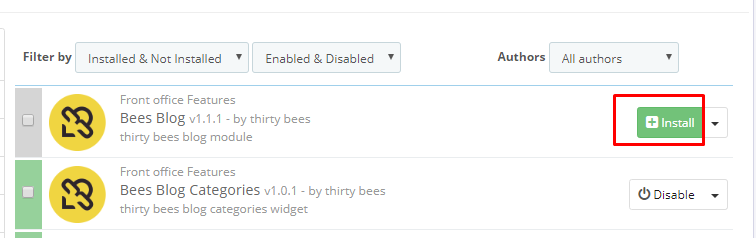
Once again, login to your prestashop-thirtybees backoffice, and go to Modules and services. Type the word Blog in the search field, like so.
blog module for prestashop-thirtybees
Click the install button to install the module. After installing the module, the first thing you see is the configuration page.

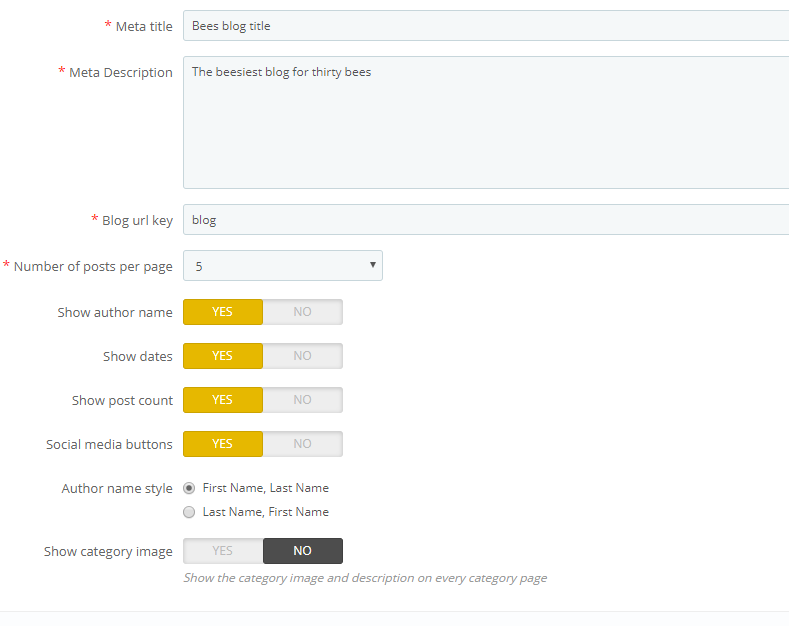
Here are the basics configuration of the blog module. Let’s go through the options one by one.
prestashop module
  • Meta title – the title of your blog. Example, Powertools Blog, or Baby's toys
  • Blog. Keep the title  short as possible without sacrificing the theme of your blog.
  • Meta description – Should describe what your products are all about or your ecommerce website is selling. Spend a little bit of time to construct your blog description.
  • Blog url key – this will be the base URL of your blog, e.g.: https://example.com/en/blog. For usefulness purposes, blog will do.
  • Number of posts per page – The number of posts to show on e.g. a category page
  • Show author name – Author names will be hidden if this is disabled
  • Show dates – Show published dates
  • Post count – show how many views a post has
  • Social media button – Show buttons to share the module
  • Author name style – First Name, Last Name or Last Name, First Name
  • Show category image – Show the current category image at the top of the current category page
  • Lastly, if you have a disqus username, scroll to the bottom of the page, unlock the comment section by adding your username in the space provided. If you do not have a disqus account, register over at disqus.com for a free one, then come back and add it.

Adding your first website blog category

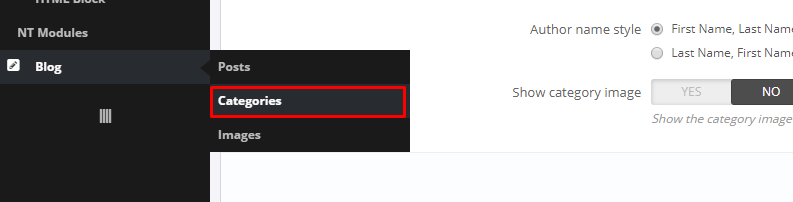
To add your first blog category, click on the Blog menu near the bottom on the left column, then click Categories. Adding a category is necessary before you can start adding you post contents.
prestashop module

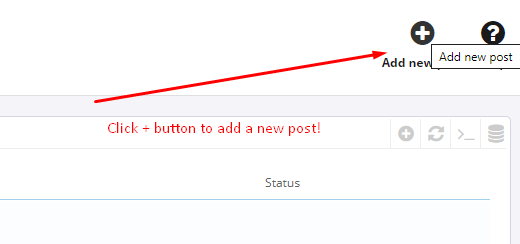
Adding the first post

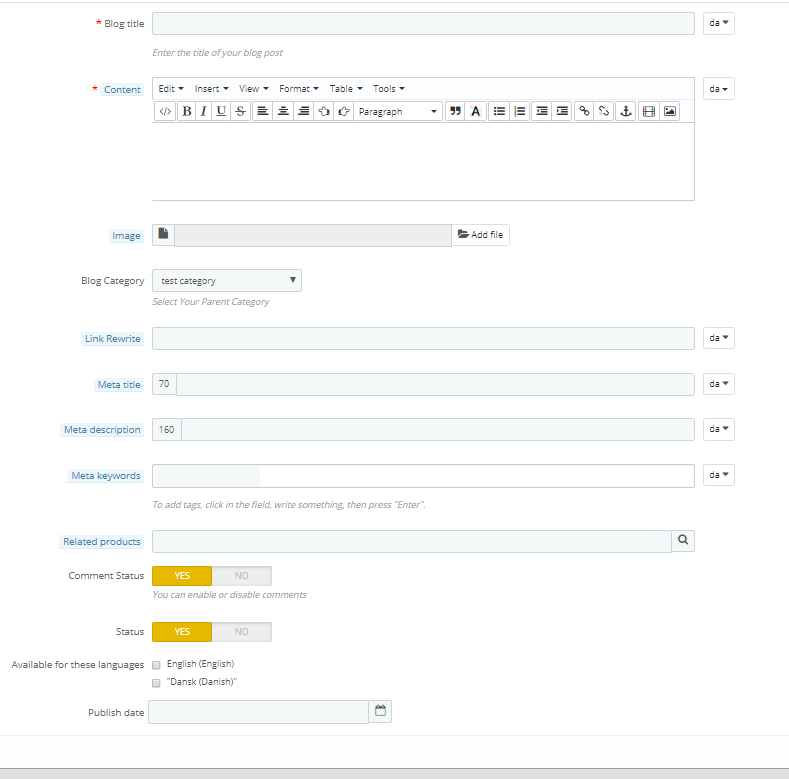
Hover on the Blog menu, and click Posts to add your first post.  The following are the settings available for you.
prestashop blog module
  • Blog title – The title of your post
  • Content – Your post’s content
  • Image – Set an header image (shown on both the blog post page and the category page)
  • Blog category – Parent category of the blog post
  • Link rewrite – the URL key of the blog post
  • Comment status – Should comments be shown?
  • Status – Is the blog post enabled?
  • Available for these language – You can choose to hide the blog post for several languages
  • Publish date – Choose a date for publication
prestashop blog module
Don't forget to click Save to save your work!

Adding a Blog menu item on the top menu

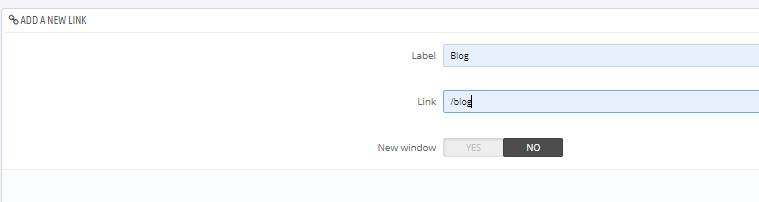
After you have gone through all these steps your blog will be available on the URL you have chosen. The blog is not automatically added to the top menu. If you want to link to your blog you can add the link manually.
To add the link, go to Modules and Services then search for blocktopmenu module. Scroll down to the bottom till you see "Add New Link", like so.
prestashop blog module
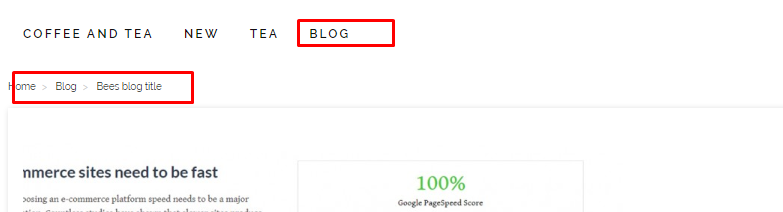
Save your work then go to the front page and refresh the page. You should be able to see your menu something like this screenshot.
prestashop module

Displaying your blog module on the left column to give it more exposure

You can hook these widgets onto your page’s columns on the back office page “Modules and Services > Positions”.

In conclusion

Blogging boost ecommerce SEO for five main reasons:

  • You blog provide fresh and consistent content that Google loves
  • Blogging is an excellent way to optimize the keywords you want to rank for in searches
  • It allows you to develop and strengthen your relationships with new and old customers through social media
  • Blogging allows you to build your links from other high quality websites because you have valuable fresh content.
  • Your blog connects people and potential customers to your brand
Click this link to download the blog module for prestashop-thritybees ecoomerce.
Check out this 13 easy ecommerce SEO tips to generate more traffic to your shop
All of our ecommerce resource are absolutely free.

Tuesday, November 26, 2019

How To Ensure Your ecommerce website is being found in Google search?

Is your ecommerce website being found in search engine searches? If not, what can you do to make your ecommerce website get found in Google search? This is the exact question I read from a desperate owner of a new online seller in one of the chat room i frequent in one of the social media platforms.
There is no acceptable argument to say that organic traffic is NOT the best kind of traffic, because it is! You’ll want to be doing all you can to encourage more of it to gain sales for your eCommerce business. However, getting those beneficial free clicks, visits and purchases can be tricky if you don’t have a good grasp on your Search Engine Optimisation strategy.

So, what should you be doing to ensure that your business is being found in search results?

#1. Foremost of your priority is to create unique and quality contents on a consistent basis.

This means unique product descriptions and titles. Don’t use a repetitive formula for all your products, even if they are similar. Google loves websites, -ecommerce or not - that has fresh and relevant contents.

Why does Google love fresh and unique contents?

The simple answer is that, Google is a search provider. They want to display content results that are new. Imagine if all they could come up with are contents written 5 years ago, every time someone submits a query. I bet you, people are not going to like it. I won't like it either! As a content creator, you should take the time to not only check your personal site for duplicate content, but also to check that it doesn’t match the product descriptions used by your competitors.

#2. This has been mentioned a lot on many pages, but a good Meta Description is an indispensable part of ensuring that your ecommerce website gets found in Google.

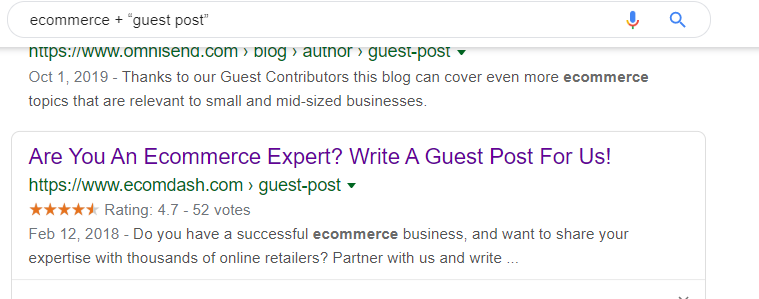
It encourages consumers to click on your site. With eCommerce, many consumers when searching Google to find what they are looking for are particularly swayed by a good meta description. Check this search results i got when search for the keywords "ecommerce + 'guest post'":
ecommerce website
The link display above is listed 6th on the first page, but I clicked it because it gave me a really compelling description. You get what I mean?
Meta descriptions could be the difference between a customer clicking on your link, or the one above it or below it. Ensure that your meta description describes your link aptly and convincingly. This is why SEO helps ecommerce Google ranking.

#3. Put premium on page load speed when developing your ecommerce website.

Slow loading pages can easily put off consumers when they are trying to shop. Understand that we are living in a world of instant gratification. Imagine a customer trying to access your product page and it is taking eternity to load and then crashes when they are trying to purchase something. That is unimaginable in 2020's web speed.
Note: As the majority of online shopping these days is performed on mobile phones, it’s imperative that you optimize your mobile loading speed.

#4. Implement structured data and schema to help Google interpret your contents better.

Structured data and Schema may not be a ranking factor but it is an essential part of content classification by Google. As more and more contents are created, it becomes harder and harder for search engines to properly interpret certain contents. Structured data and schema allows Google to do exactly that - read and interpret your content properly to enable them to display results better with rich snippets.

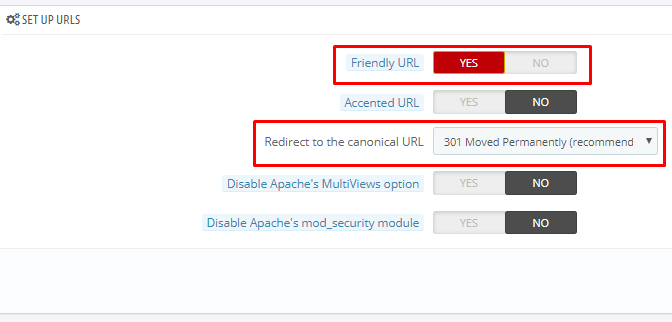
#5. Set SEO URL for search engines to avoid Google attempting to crawl through long and arduous URLs

Long URLS are common with eCommerce websites, due  to the nature of how the system runs. If your ecommerce system does not allow you to implement SEO friendly URLS, I suggest switching to one that does it good like prestashop-thirtybees. SEO friendly URLS are especially important for eCommerce websites which have hundreds of products. If you are using prestashop-thirtybees system, you can easily set up freindly URLs through the back office.

Check out the tutorial Optimize Prestashop-thirtybees seo-urls for Better Search Visibility.

#6. Established your link profile through link building.

Your link profile is the source of referred traffic to your website or product by external, established sites. The more links your have from other websites the better. Search engines interpret links to your website as a sign of authority and popularity. There are two ways to get your link profile built. You can do it free, or you can buy links from people who sells link building services.
One of the best source of free referred traffic is social media. Establish a social media strategy for your ecommerce asap, if you don't have one.

#7. Engage with people in your niche to establish your authority.

Share your expertise. Do not sell but give value to others. This way, you are establishing yourself as an expert and authority in your field. In time, it will encourage customers to act as your own personal salespeople through their reviews and impression of you. The greatest mistakes that merchants do in when it comes to engagement is, they sell. Of course we have to sell, but we have to be authentic first. The great thing about having an eCommerce business is that you have a wealth of opportunity for customers to write and post comments, therefore promoting your business for you. Google loves testimonials, and enough of them could significantly help your rankings on the search engine.

In conclusion

Having an ecommerce website is just your first step to making sales. You have to do something so that Google search engine finds you and rank you. Work on these suggested to do list to ensure your ecommerce website gets found in searches.

Monday, November 25, 2019

Two Reasons Why SEO helps your ecommerce business?

There is undeniable reasons why SEO helps your ecommerce website today. People have increasingly been using Google search to look for almost about anything they want to be informed about. Take a look at the following data coming from smartinsights:
The number of people using internet search engines is increasing year on year and is almost unfathomable. Using the above Market Share chart and the data from Internet live stats, we can see the number of daily searches on Google - 3.5 billion, which equates to 1.2 trillion searches per year worldwide.
Source 
Undoubtedly, the need for search engine optimization to work in your favor, gets even crucial as you begin to understand why SEO helps your ecommerce. Big companies have been using it to get more revenues. Small businesses uses it to get found and get more sales lead.
The following are two undeniable reasons why SEO helps your ecommerce business

#1. Search engine optimization can help customers find you

Without SEO, customers will find it hard to get to your store  in the sea of ecommerce pages. It would be impossible for your to reach more people to get more sales and valuable customers. So, embracing an SEO-first approach to your ecommerce website, is a must.
There are tons and tons of pages that search engine processes every minute. The questions is, how will your product pages be found in such a gargantuan heap of digital information? The simple answer is to embrace an SEO-first approach. As in any endeavor in real life, it takes time and doing things consistently to be an expert in that field.

Build your expertise in your particular niche

I was watching kungfu movies over that weekend. In the movie, the master was asked by a loud student,
"Master, how long is it going to take me to be at your level? and the master said, "If you practice everyday for 10 years, you might get to  2nd level! And there are 7 levels of mastery you have to go through!"
So, coming back to SEO - to have an SEO-first attitude, you need to be an EXPERT first in your field. And you are not going to reach that level without doing the same thing over and over again for at least 5 years.
Build your expertise. This means that you need to illustrate your skills as the creator and publisher of contents. It is not going to be pretty at first but by remaining honest and producing valuable content, any site—regardless of its specific industry—can emphasize its expertise.
Harness the power of words to get your brand noticed. Design and launch a streamlined and SEO-friendly e-commerce store that yields great results.

Demonstrate an authoritativeness as a creator of contents.

You can do this by encouraging your expert content creators to add their names and credentials to their pieces. This gives readers a better idea of where the information they are being given is coming from—and if it is reliable.
If the content you’re presenting is scientific or studied in nature, then it’s imperative to supply appropriate citations. However, no matter what type of content is presented, offering the reader a picture of the author, accompanied by a brief biography, does a great job of humanizing your brand and promoting transparency among your audience.

Show users that they can trust you

This idea is particularly important for eCommerce websites because we request information from customers at the payment process. Your users should feel safe giving away personal and financial information to your site. As content creator, your content should be able to help and teach users something that would add value to them as users. People tend to give money away when they receive more from you. That is the natural order of things. Trust is not built on  what you have, but on what you can give and what you can add to others' lives on a consistent basis.
Consistency is such an important concept when it comes to ecommerce user experiences, and the effects it has on the user in terms of trust. When a user uses your ecommerce platform, they learn how it works, they learn where things are, and they learn who you are. And as they begin to see that you can be trusted, it boost your conversions. Your users learn to trust your website more and more, they tend to recommend it to family and friends. And that's how you grow your brand organically!

Building trust is not a matter of choice, but of necessity.

However, no one is going to trust you when they can't even find you, right? This is where SEO comes in for your ecommerce business - SEO helps your customers to find you on search engine searches. So, to underline the importance of how SEO helps your ecommerce business, write contents showing you are an expert and an authority in your field.

#2. SEO produces cost-effective, long-lasting and quantifiable results.

Search Engine Optimization, or SEO, is often lauded as being one of the more affordable and cost effective forms of online advertising. While this can be true, it is important to remember that an SEO campaign is not a one-time endeavor but should be an ongoing process to ensure the best results.

Every page is a potential SEO campaign

Every individual page on your site should be treated as a separate potential SEO campaign. By establishing a single campaign per page you can ensure that each page is properly optimized. Because each page have unique contents that targets relatively different type of audience in your niche.
By doing so, it helps to ensure a more effective SEO marketing campaign for your ecommerce website as a whole, it also enables easier tracking of performance and monitoring of ROI. Most pages will have different requirements according to the competitiveness of keywords and the return per lead for each page. Tailoring an SEO campaign to meet these individual requirements helps to ensure its effectiveness.

Building powerful link profile sets you up for a long-lasting SEO

SEO is not a one-off marketing package. Everything about an SEO campaign should be regularly monitored and optimized according to results and other figures. Keyword popularity and the number of sites competing for the top positions can make some keywords less competitive while others become more appealing.
Sites that are caught up in highly competitive niches will find that they need to build a particularly powerful link profile. This will take time, especially if the link profile is to appear natural to the search engines. Pages that are less competitive will need to keep their profile updated and ensure that they are still targeting appropriate keywords.

In conclusion

SEO is a powerful and cost-effective tool for your ecommerce SEO. Doing so gets you found in Google search in the first place. Start building your contents until you become and expert and authority in your field asap.
Check out the following ecommerce SEO related posts to expand your knowledge and how you can use it to your advantage.
Page Load Speed! How fast is fast enough for your ecommerce SEO?
13 easy ecommerce SEO tips to generate more traffic to your shop
Does Blogging Help Boost Your Ecommerce SEO?

Friday, November 22, 2019

Increase Visibility with Prestashop-thirtybees CMS Module

The Prestashop-thirtybees CMS module pages is one of the main feature that is often underused. Easily build content to increase your visibility in addition to your product pages with cms module. This post is meant to allow anyone to optimize the presentation of this native functionality of your prestashop-thritybees store!

The Prestashop-thirtybees CMS module for pages

This module allows you to create a real living "bible" of content on your ecommerce store, but for that you need to correctly configure the CMS blocks module and arrange your content intelligently. It is important to centralize the CMS blocks to give a real sense of entity and not to let these module blocks hang around anywhere on your shop.
When creating contents with CMS module, consider using external tools such as layoutit, to generate fully responsive content, especially if without having any programming skills or limited knowledge in programming. Although prestashop-thirtybees ecommerce comes with the native TinyMCE editor, it is not optimized for the creation of multi-media content. But if that is not an option for you, TinyMCE would be fine.

The Usefulness of CMS block module pages?

Prestashop-thirtybees CMS block module is a very handy tool for making presentation pages for your ecommerce website. It can also be used to create posts for your store blog(thirtybees comes with a native blog to be used for blogging contents which will allow you more control of your contents outside of the products).
Another use for the CMS block module is for your website's FAQ pages. It really comes in handy. And of course, publishing new information for your users to consume.

Let's get into it!

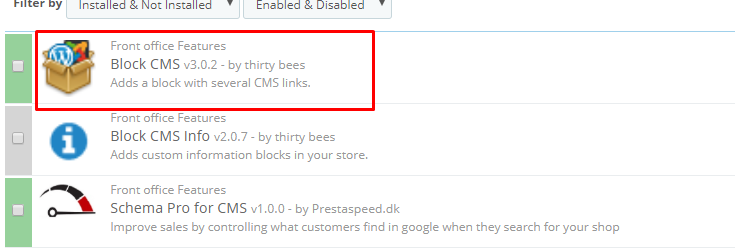
As usual, you need to go login to your back office dashboard. Surf down to Modules and Services, and search the modules by typing the word "cms". The system will give you three options like the screenshot below, like so.
cms module
Click the Configure button and check the contents that is in there. At this point, you don't need to change anything. What we are after is for you to familiarize with how this CMS module is set up. Click save.

Enabling the CMS block module in your theme

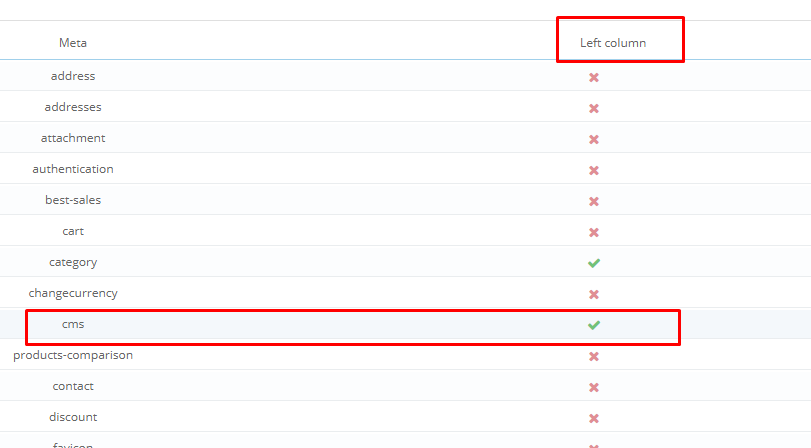
You need to enable the CMS module block to make it appear in the front office. To do that, go to Preferences, then Themes. You will see the theme you are using at the top of the page, look for Advance Settings, then click it. What we are going to do here is to check if our CMS module is enabled to display in the left column of your shop. If it is not, click the "x" button to enable it, like so. Then click Save, like so.
cms block module

Checking if Left Column displays in CMS pages.

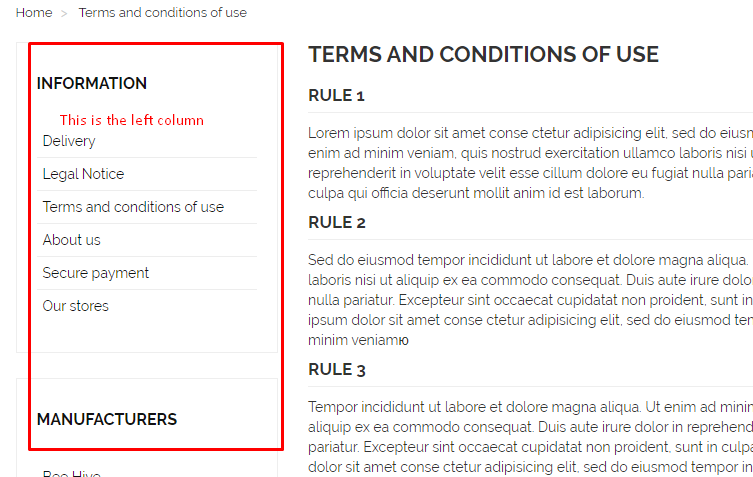
Now that your CMS module is enabled, you should be able to see it in your website. To see, it, click on any information page like "About us" or "terms and condition" page. You should see your left column enabled. There will be a bunch of other modules that you will see together with the CMS module block. Some of it are necessary, but others you may have to remove. Let's remove the ones that are on top of the left column, this should be the categories block and Best Seller block.
cms block module

Removing unnecessary blocks on the left column

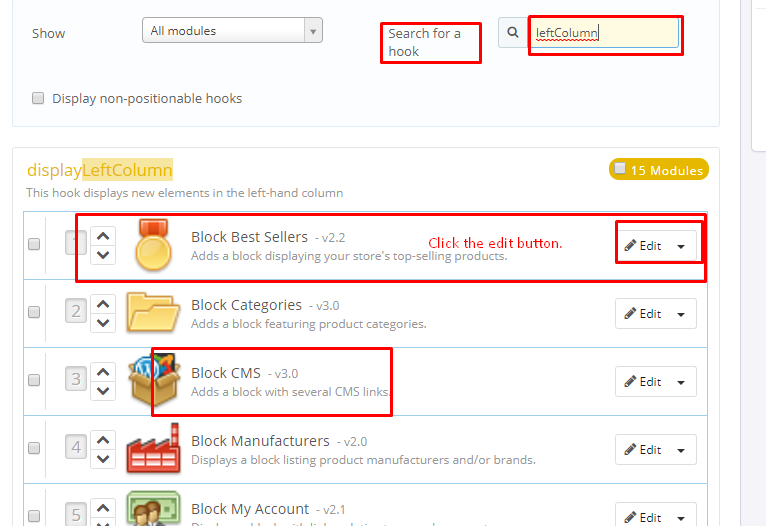
It is so simple to do this. All you need to do is go to Modules and Services, then click on Positions. Once inside, go to the upper left side of the page and look for the line "Search for a hook". Type in the word leftColumn,  it should give you the contents just like the image below.
cms block module
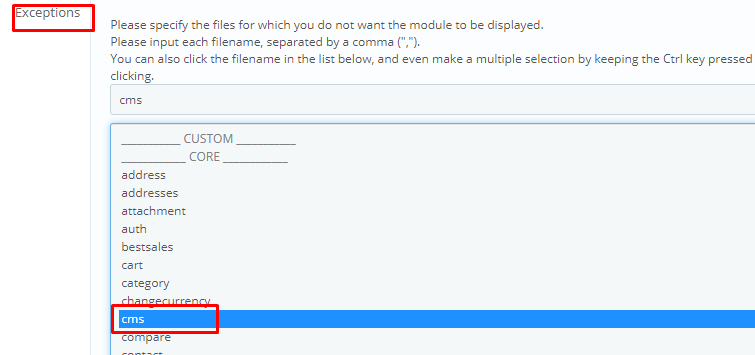
To un-display the Best Sellers block and the Categories block, click on the Edit button. Look for the Exceptions table that says:
Exceptions
Please specify the files for which you do not want the module to be displayed.
Please input each filename, separated by a comma (",").
You can also click the filename in the list below, and even make a multiple selection by keeping the Ctrl key pressed while clicking, or choose a whole range of filename by keeping the Shift key pressed while clicking.
cms block
scroll down and click on the CMS, then click Save. Doing this means that, this particular block will not be displayed on the CMS module contents or pages.
If you go to your front office again and click on the page you were in before, then hit refresh, you should not be able to see the Best Seller block. Do the same with the Categories block, or un-display/display blocks as much as you like. The purpose of this exercise is to get familiarize how blocks are being displayed in your prestashop-thirtybees ecommerce system.

Creating your first CMS page

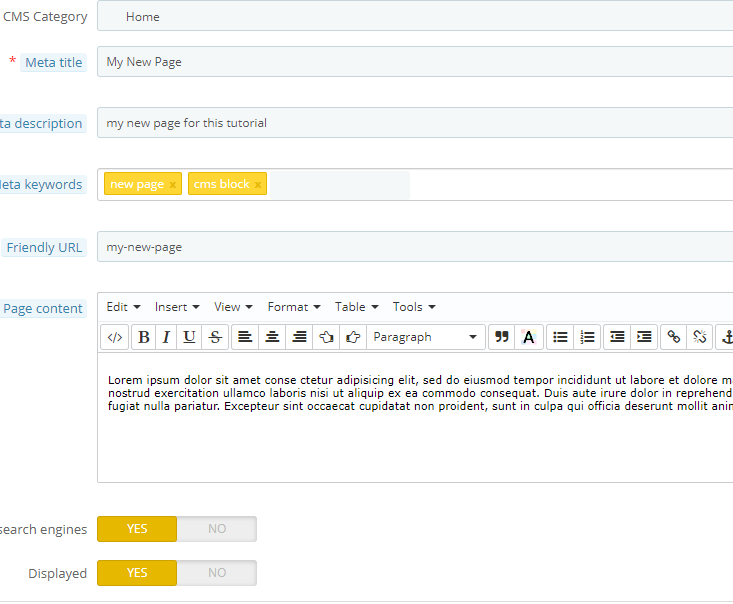
Alright! You are basically done with learning the CMS block module. You were able to activate the left column to display the CMS pages, then we hide the blocks that were not necessary. Now all you need to do is create a new CMS page. To do this, go to Preferences then CMS, like so.
cms block module
Don't forget to click the Save button at the bottom right of the page.

Displaying your new content page in the CMS module block and footer block

The page link to your new content will not be displayed yet in the CMS block. You have to do one more step to be able to make it display as you wish it. To do this, you have to go back to the Modules and Services, then search for the CMS module, click configure.
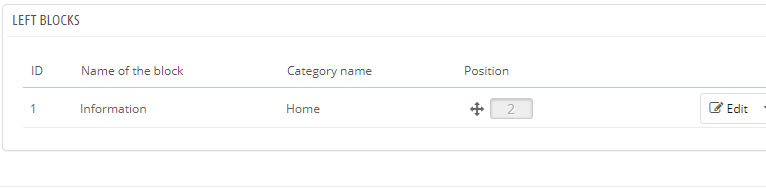
Once at the configuration page scroll down a little till you see this,
cms block module
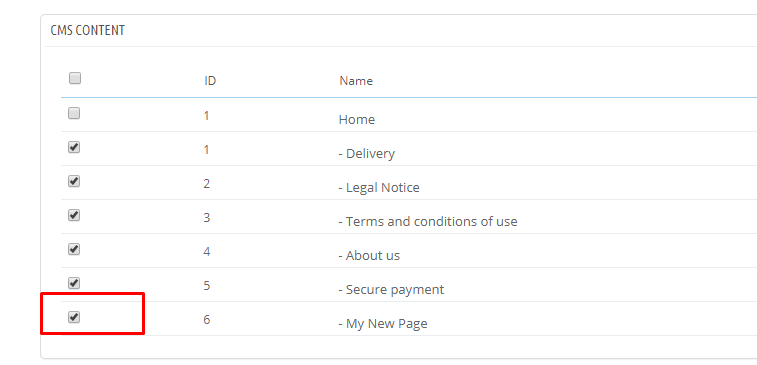
Click the Edit button, then look for the title of your new page(mine is "My New Page"), then check the check box to display it along with the information pages your have. Click Save.
cms block module
If you want your new page to display at the footer, you will have to enable it too. Look for the sentence,
"Display various links and information in the footer"
Look for the title of your new page, then check the check box to display it along with the information pages your have. Click Save.
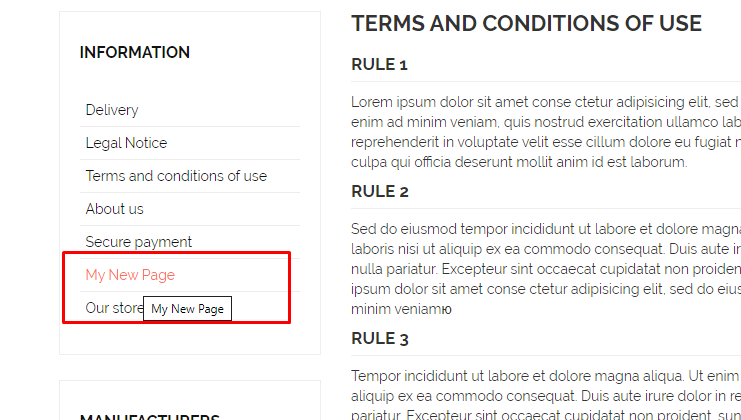
Now your new CMS page should be visible in the CMS block module and the footer of your store, like so.
cms module
Alright!! So far so good! We are basically DONE!

In conclusion

Setting up and configuring the prestashop-thirtybees CMS module block  is quite tricky for the untrained eye. But once you get familiar with it, it is actually easy.
Find great ecommerce resource to gain more sales out of your ecommerce website
Double your sales with Customer Loyalty programs
Reward your loyal customers with referral programs

Wednesday, November 20, 2019

Reward Your Customers with thirtybees Ecommerce Referral Program

When running an ecommerce referral program, remember these three very important points:

#1. Give people a self-serving reason to WANT to talk about your product and refer you. If what you offer is uninteresting, people wont refer it. So, make a compelling reason for them to refer.
#2. Make it really easy for your customers to refer you and they’d be happy to do it!
#3. Get influential people to endorse you. There are “influencers” who can bring you new buyers (because they are looking for ways to save money). I see a lot of shops and yet, I seldom see them highlighting affiliate program. While it is not complicated to use, only a few really explains how this work to customers. In fact, if you do this, go extra further and make a video that explains your approach, why you put this program in place and why everyone is a winner (to reassure them too).
Reward Your Customers with thirtybees Ecommerce Referral Program

Tuesday, November 19, 2019

Page Load Speed! How fast is fast enough for your ecommerce SEO?

Page load speed is one of the top priority for ecommerce owners. it should be. Improvements on this area must be high on your ecommerce website to-do lists. In fact, it should have been there at the onset of development. Not counting better user experience.

Is Improve page load speed a worthwhile priority?

Absolutely! Page load speed raises your shops potential for increased revenue as well as better organic search rankings. You may ask, how? The answer lies in what searchers does after clicking your link. Let us do some SEO math:
Slow website = Higher bounce rate. Higher bounce rate is translated as a bad user experience by Google.
Bad user experience = Lower Google ranking. That is how website page load speed matters to your ecommerce SEO

What is a Bounce rate?

To understand better, check this definition from one of the top seo guys in the industry. Google support itself.
A bounce is a single-page session on your site. In Analytics, a bounce is calculated specifically as a session that triggers only a single request to the Analytics server, such as when a user opens a single page on your site and then exits without triggering any other requests to the Analytics server during that session.
Bounce rate is single-page sessions divided by all sessions, or the percentage of all sessions on your site in which users viewed only a single page and triggered only a single request to the Analytics server.
Google loves websites that are faster because they can provide better experience for searchers, and also are more likely to drive revenue. Thus, Google asserts, you should make your site faster regardless of whether it helps your organic rankings directly or not.

What does it mean to say that your goal is faster page speed?

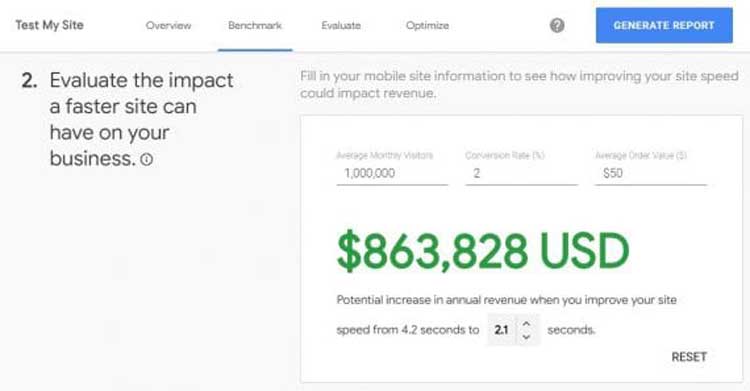
To help us understand this, Google came up with a revenue calculator, shown below. This app estimates the value of optimizing your site’s speed based on your analytics data. All you got to do is plug in your traffic, conversion rate, and average order value, and Google spits out a revenue projection.
page load speed
So, in simple terms, faster page load speed equates to more revenue, according to google. And it makes sense for a  couple of reasons: Better user experience which leads to happy customers, and better search engine ranking for the website.
So, a reduction of website page load speed from 4.2 seconds to 2.1 seconds with 1M monthly visitors and a 50$ average order will result to a million more $$$ in revenue. This is what it means to state a goal of a better page load speed.

The science of fast page load speed for ecommerce system.

Of all the website systems in the world, ecommerce systems and platforms are the ones that have to be up there in speed. But there are barriers to discussing page speed between marketing and development teams because of the lack of communication standard. It can not be overstate enough that both sides need to understand the metrics beyond “just make it faster.”
A couple of points regarding this communication standard need to be set: One is the "First page paint" and the other is the "Full Page paint". Therefore, development teams should make it a point not to preload javascript files and third-party script files. Async-await can be use for this, or simply place the call at the footer after the initial page is loaded.
First page paint is the initial loading of your page without the javascript and third-party scripts. It is the time between navigation and when the browser render the first pixels of your website to the screen.
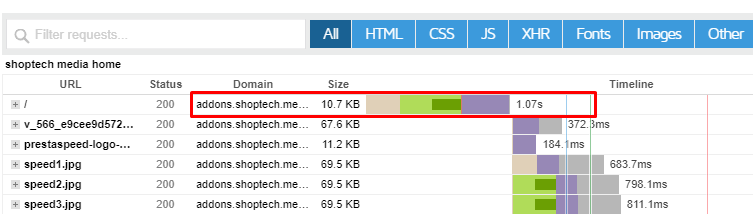
At normal development, without further SEO work, our ecommerce development process using thirtybees platform generates a 1.07s. The average accepted page load speed to be called a good website is 3.5sec. Within 3.5 seconds, your visitors should at least be able to see the website navigation. And see the fully loaded ecommerce website within 8.5 seconds.
page load speed
You may notice that, even without further optimization, our ecommerce system is more than 2 seconds faster than a standard ecommerce website.
This is the page load speed performance of our ecommerce system after fully loaded without speed optimization.
page load speed
Our deliverable is usually below 1 second of page load speed! Take for example this one ecommerce website developed in thirtybees system which is way below 1 sec with speed optimization.
page load speed
Because we understand that website speed is crucial for every ecommerce website we develop!
We can never stress page speed enough. We are proud of our ecommerce system because we build each with speed and your revenue in mind!

Now  a couple of things for the technically-minded. Google does offer two toolsets to help you out with page load speed.

PageSpeed Insights is the more user-friendly of the two. It shows a handy one-size-fits-all PageSpeed Score from 1 to 100 — which sadly does not correlate to whether you’re receiving the page speed rankings boost — alongside some detailed recommendations for how to improve.
Lighthouse crosses into developer mode with waterfall data for debugging. But it still offers the simple scoring and easier-to-understand recommendations of PageSpeed Insights.

In conclusion:

So, how fast is fast page load speed? A standard ecommerce page load speed should aim for a "First paint" of 3 seconds. This should give your users plenty of time to check out your website rather than spend them waiting for loading time. And at 8 seconds, your webpage should be fully loaded. However, to get past your competition, it is not enough just to be average and normal. Aim for the speed of 1 second, that would really give your website a boost in search engine ranking and increase your revenue as well.
Need help with developing a fast ecommerce website? Check us out using the contact form.
Don't forget to tell us about what you think in the comment section. And if I may, please share this content to your social media friends. thanks and be blessed!

Monday, November 18, 2019

13 easy ecommerce SEO tips to generate more traffic to your shop

There are a number of ecommerce seo tips your can implement to optimize your website to generate more traffic—such as by including calls to action and lead capture forms in the right places, providing the information your visitors are seeking, and making navigation easy and intuitive. Your goal when it comes to generating more website traffic is to be driving more qualified visitors to your site. That is, those who are most likely to convert into leads and customers.
These Ecommerce SEO tips are designed to generate traffic to your website to improve your rank which in turn juices more traffic from search engines, social media sites, etc. Although what you want to make sure is that the increase in traffic be associated with an increase in engagement as well. If your traffic is increasing but your conversion rates are decreasing, you’re not bringing in the right traffic. Everything is going to start with generating more and more traffic first.

I have gathered 13 ecommerce SEO tips for you to  easily implement to generate more traffic to your shop

Tip #1. Every ecommerce website should have a sitemap. Install/enable your sitemap and set it to regularly generate and update your content links.

Tip #2. Implement Schema and structured data

Tip #3. Focus on improving your anchor link text

Tip #4. Make sure your pages are responsive and displays well in both desktop and small devices.

Mobile responsiveness is one of the most important elements of a ecommerce seo to make your website search engine friendly.

Tip #5. Another easy ecommerce SEO tip is to always optimize your images with alt tags.


Tip #6. Do a keyword research, refine it, and do it as often as you need.

Check this additional resource discover your product defining keywords

Tip #7. A well-written product description has the power to move your customers through your sales funnel.

Tip #8. Maintain content freshness for frequent indexing

The main goal of a search engine like Google is to offer the most relevant information based on user-provided search queries.

Tip #9. Improve your page relevancy with your keyword

Tip #10. Work on good site navigation and offer a better way for customers to find your products while in your site

Another thing you can do to improve site navigation tremendously is installing a layered navigation module or extension.

Tip #11. Work on improving website speed. Check and recheck regularly if everything is working and at speed as it should.

Tip #12. Keep publishing contents and pages.

Your frequently updated website offers search engines a haven for fresh content and sources of new information for their search requests. The same reason why a blog have become an essential part of an ecommerce website today!

Tip #13. Create Google My Business to generate more search engine traffic

This is why Google My Business checks out as the best free website traffic generator. It:

Pretty cool stuff!

In conclusion

Getting ecommerce website traffic does not have to cost you monetarily, but it will require effort on your part. However, the effort you put in will equate to the quality of the traffic you generate.
Implement these 13 easy ecommerce SEO tips to generate more traffic to your shop as soon as possible and see your traffic go up.
Share this content to friends! Tell us what you think about these 13 tips in the comment section. ciao :)